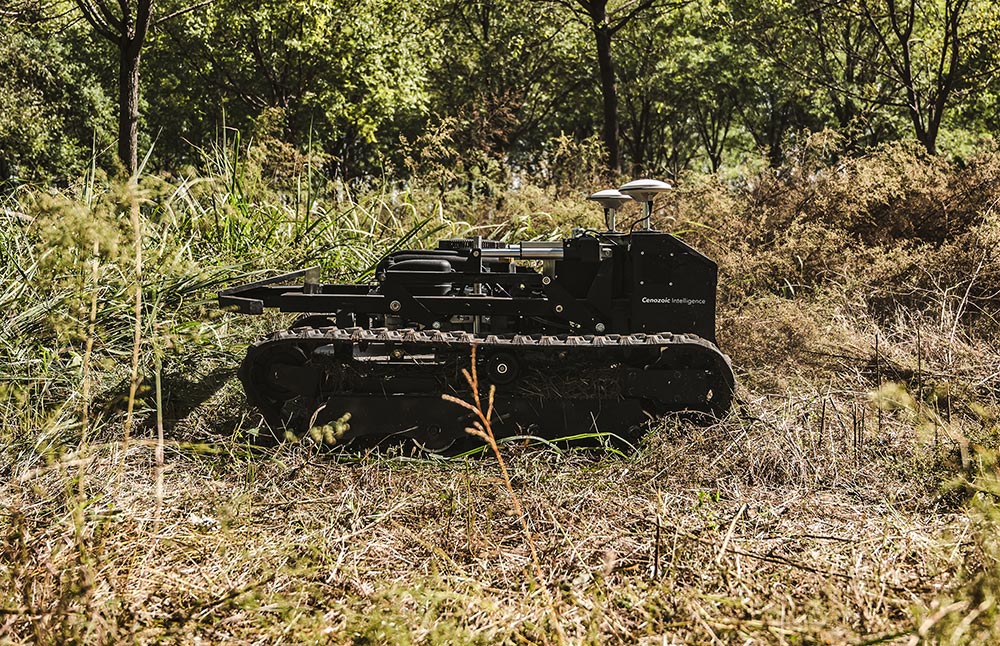
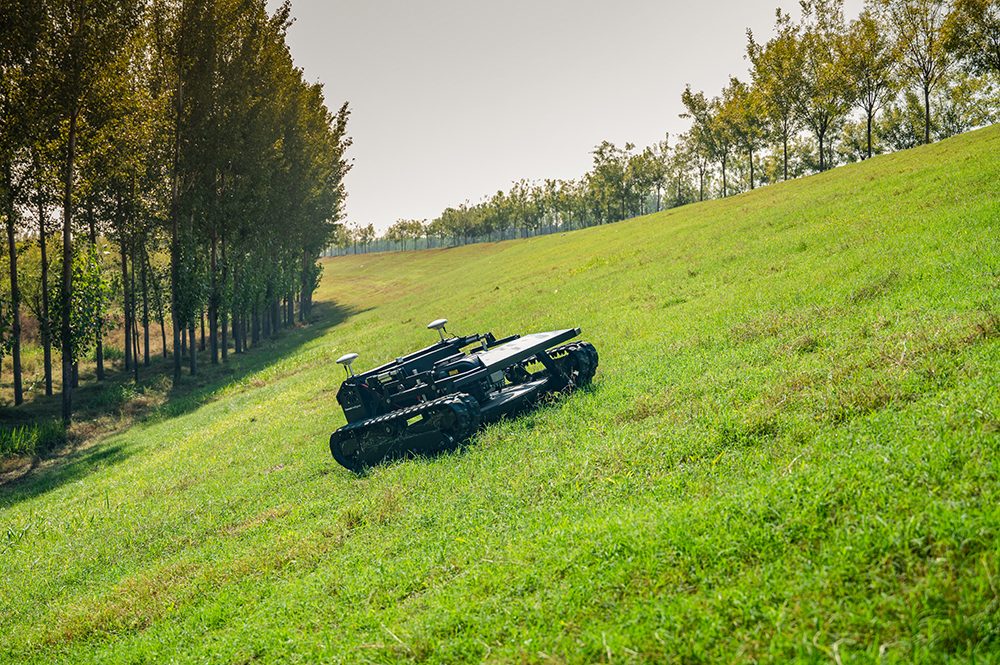
In high-risk environments such as reservoir dams, highway slopes, hilly mountainous areas, and solar power fields, 40-degree steep slopes represent the ultimate challenge for commercial vegetation management equipment. SuZhou Cenozoic Intelligence Equipment Pte.,Ltd Cenozoic T1 commercial tracked mowing robot has undergone comprehensive specialized design for this extreme operating condition. This ensures the machine meets the following three critical performance metrics when performing lateral mowing operations on slopes of 40 degrees (approximately 83.9% gradient):
I. Core Design Objectives and Physical Constraints
1. Anti-Rollover: Prevent lateral tipping toward the slope’s base.
2. Anti-Slip: Ensure tracks provide sufficient traction to avoid longitudinal slippage or lateral sliding.
3. Precision Tracking: Maintain a straight, bow-shaped cutting trajectory even under extreme stress conditions.
II. Physical Architecture Reconstruction: Ultra-Low Center of Gravity (CG) Chassis Design
To counteract the overturning moment on a 40-degree slope, a fundamental redesign of the chassis geometry is essential. Based on the critical anti-rollover formula:
h/w<1/(2×tan40∘)≈0.595
(where h is center of gravity height and w is track center distance), the Blackbird T1 employs a “matrix-style flattened layout.”
• Bottom-mounted battery and controller: The heaviest components—high-density power battery packs (e.g., lithium iron phosphate modules) and core control boards—are flat-packaged and directly anchored to the chassis’s lowest armor plate. This minimizes ground clearance to the bare minimum required for cutting disc elevation.
• Dual Motor Direct-Drive Architecture: Abandoning cumbersome gearbox transmission, it employs dual independent brushless direct-drive motors. The motor shafts are positioned as low as possible, aligning with the track drive wheels to further lower the overall center of gravity.
• Wide Track Design: While meeting standard commercial transport and passability requirements, the center distance (w) between left and right tracks is maximally widened. This ensures the machine’s center of gravity remains firmly within the support surface of the lower track even at a 40-degree incline.
III. Traction Assurance: Specialized Industrial Track System
When stationary or traversing a 40-degree slope, the minimum equivalent friction coefficient required to prevent slippage is μ ≥ tan(40∘) ≈ 0.839. Ordinary rubber wheels or household-grade fine-pattern tracks cannot meet this parameter.
• Ground Pressure Optimization: Wide rubber tracks significantly increase the effective contact area between the machine and the ground, reducing ground pressure per unit area and preventing sinking in soft, muddy grass.
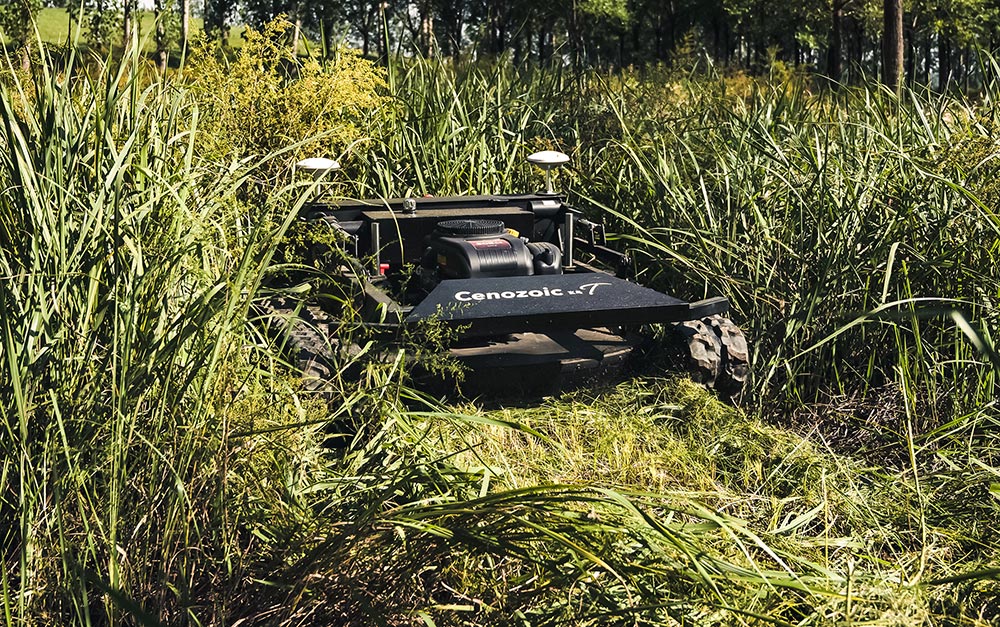
• Geometric Interlocking Deep Lug Treads: The track surface features industrial-grade deep lug treads with a herringbone pattern for superior mud evacuation. During steep slope operations, these lugs penetrate deep into the subsoil beneath the turf like studded shoes, converting simple surface friction into powerful “mechanical geometric interlocking force.” This forcibly elevates traction above the safety threshold.
• Self-Tensioning Floating Suspension: The track incorporates a spring-loaded self-tensioning idler wheel mechanism. This ensures the track maintains close contact with the ground even over uneven slopes, preventing derailment and chain drop while guaranteeing continuous power delivery.
IV. Core Algorithm: Full-Stack, In-House Developed Dynamic Posture Control
The physical chassis defines the upper limit of capability, while the core algorithm determines whether the machine can operate stably at the edge of its limits. Leveraging deep expertise in robotics R&D, Suzhou New Coordinate Intelligence addresses yaw issues caused by slope slippage through proprietary motion control algorithms.
• Millisecond-Level Slip Detection: The system integrates 6-axis attitude data from a high-precision IMU (Inertial Measurement Unit) with high-resolution encoder data from dual-side drive motors. When a minor slip occurs on one track—such as on dew-covered grass or gravel (where actual displacement is less than the motor’s theoretical rotation)—the system identifies the slipping trend within milliseconds.
• Dynamic Torque Vectoring: Upon detecting slip or yaw-induced nose-down tilt, the underlying anti-slip compensation algorithm instantly activates. The system rapidly reduces output torque (or even applies slight braking) to the slipping motor while increasing torque to the motor on the side with good traction. This forcibly corrects the vehicle’s posture, ensuring the machine maintains a perfectly straight cutting line even on 40-degree slopes.
V. Engineering Boundaries and Ultimate Safety Redundancy
In high-risk commercial environments, safety demands redundant design. Particularly in areas with severe signal obstruction and multipath effects—such as beneath photovoltaic panels—reliance solely on autonomous navigation poses lethal risks.
• Power-Off Electromagnetic Braking: A normally closed electromagnetic brake is integrated at the rear of the drive motor. Should system power failure, battery overheating, or emergency stop activation occur on steep slopes, the electromagnetic brake instantly locks the tracks, anchoring the machine firmly on 40-degree inclines to prevent any slippage.
• Industrial-Grade Low-Latency Remote Takeover: When encountering safety boundaries beyond the system’s autonomous planning capabilities—such as extreme proximity to high-voltage photovoltaic cables or encountering unknown cliffs exceeding 40 degrees—the system supports seamless switching to low-latency video transmission remote control mode. Operators can take control of the machine’s posture from a safe location, leveraging the machine’s extreme off-road capabilities while adding human visual judgment as a final safeguard, ensuring absolute security for assets worth tens of millions.